
-


Vetus Bow Thrusters - BOW9512 Electric 12V 209.4 lbf (95.0 kgf)
VTSBOW9512D
$3,901.41 USDList Price: $4,876.76 USDUnit price /Unavailable -
Vetus Bow Thrusters - BOW5524 Electric 24V 121.2 lbf (55.0 kgf)
VTSBOW5524D
$2,137.42 USDList Price: $2,671.78 USDUnit price /Unavailable -

Side-Power (Sleipner) Bow Thrusters - E170 Electric 24V 374.8 lbf (170.0 kgf) IP
SIDE170250TC24V
$8,787.74 USDUnit price /Unavailable -

Lewmar Bow Thrusters - 300TT Electric 24V 551.2 lbf (250.0 kgf) (AL)
LEW590033
$7,613.00 USDList Price: $13,114.95 USDUnit price /Unavailable -
Lewmar Bow Thrusters - 185TT Electric 24V 143.3 lbf (65.0 kgf)
LEW590009
$2,618.00 USDList Price: $4,366.95 USDUnit price /Unavailable -
Lewmar Bow Thrusters - 185TT Electric 12V 127.8 lbf (58.0 kgf)
LEW590006
$2,074.00 USDList Price: $3,458.95 USDUnit price /Unavailable -
Lewmar Bow Thrusters - 140TT Electric 12V 92.6 lbf (42.0 kgf) IP
LEW590005
$2,430.00 USDList Price: $4,052.95 USDUnit price /Unavailable -
Lewmar Bow Thrusters - 140TT Electric 12V 92.6 lbf (42.0 kgf)
LEW590003
$1,733.00 USDList Price: $2,890.95 USDUnit price /Unavailable -
Vetus Bow Thrusters - 665 Hydraulic 661.5 lbf (300.0 kgf)
VTSBOW310HMD
$5,501.71 USDList Price: $6,877.14 USDUnit price /Unavailable -
Vetus Bow Thrusters - 507 Hydraulic 507.1 lbf (230.0 kgf)
VTSBOW230HMD
$5,124.09 USDList Price: $6,405.11 USDUnit price /Unavailable -
Vetus Bow Thrusters - 352 Hydraulic 352.8 lbf (160.0 kgf)
VTSBOW160HMD
$3,695.10 USDList Price: $4,618.88 USDUnit price /Unavailable -
Vetus Bow Thrusters - 210 Hydraulic 209.4 lbf (95.0 kgf)
VTSBOW95HMD
$3,057.86 USDList Price: $3,822.33 USDUnit price /Unavailable -
Vetus Bow Thrusters - 121 Hydraulic 121.2 lbf (55.0 kgf)
VTSBOW55HMD
$2,550.30 USDList Price: $3,187.87 USDUnit price /Unavailable -
Vetus Bow Thrusters - BOW9524 Electric 24V 209.4 lbf (95.0 kgf) IP
VTSBOW9524DI
$4,825.85 USDList Price: $6,032.31 USDUnit price /Unavailable -
Vetus Bow Thrusters - BOW9524 Electric 24V 209.4 lbf (95.0 kgf)
VTSBOW9524D
$3,901.41 USDList Price: $4,876.76 USDUnit price /Unavailable -
Vetus Bow Thrusters - BOW9512 Electric 12V 209.4 lbf (95.0 kgf) IP
VTSBOW9512DI
$4,825.85 USDList Price: $6,032.31 USDUnit price /Unavailable -
Vetus Bow Thrusters - BOW7524 Electric 24V 165.3 lbf (75.0 kgf) IP
VTSBOW7524DI
$3,568.72 USDList Price: $4,460.90 USDUnit price /Unavailable -
Vetus Bow Thrusters - BOW7524 Electric 24V 165.3 lbf (75.0 kgf)
VTSBOW7524D
$2,716.64 USDList Price: $3,395.80 USDUnit price /Unavailable -
Vetus Bow Thrusters - BOW7512 Electric 12V 165.3 lbf (75.0 kgf) IP
VTSBOW7512DI
$3,568.72 USDList Price: $4,460.90 USDUnit price /Unavailable -
Vetus Bow Thrusters - BOW7512 Electric 12V 165.3 lbf (75.0 kgf)
VTSBOW7512D
$2,716.64 USDList Price: $3,395.80 USDUnit price /Unavailable




Bow Thrusters: Tunnel or Retractable, Thrust, 12V or 24V, and What a Kit Includes
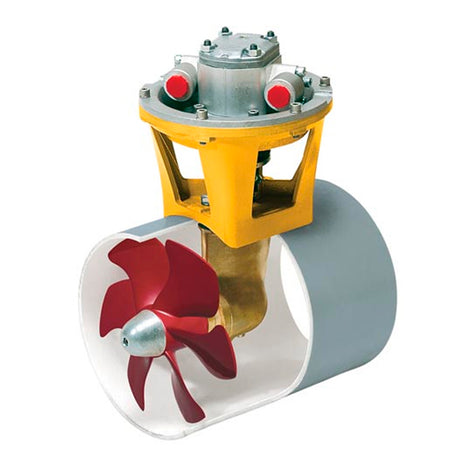
A bow thruster is a propeller in a tube through the hull that pushes the bow sideways at zero boat speed, so you can dock without relying on rudder flow. Lewmar describes its tunnel thrusters the same way: sideways thrust for bow or stern positioning, without needing forward motion. The right unit comes down to three decisions — the type that fits your hull (tunnel, retractable or external), the thrust your boat needs, and the voltage your boat can actually deliver at the motor. This collection covers all three, from Lewmar, Side-Power (Sleipner), Vetus and Quick.
Bow Thruster Families in This Collection
- Lewmar TT electric: 110TT (12V, 28 kgf), 140TT (12V, 37 and 42 kgf), 185TT (12V or 24V, 58 to 97 kgf), 250TT (24V 140 kgf, 48V 170 kgf) and 300TT (24V, 250 kgf). The number is the tunnel diameter in mm: 110, 140, 185, 250 and 300. Lewmar's TT propeller gives equal thrust in both directions. Compare the 140TT 12V and the 185TT 12V.
- Lewmar TT hydraulic: 185TT (120 kgf), 250TT (200 kgf) and 300TT (300 kgf), with twin counter-rotating propellers on the 250 and 300. Lewmar lists them as typically powered by the main engine or a generator PTO-driven pump, with more thrust than the equivalent electric TT — see the 300TT hydraulic.
- Side-Power (Sleipner) SE and SEP tunnel thrusters: SE25 to SE210 on/off, and SEP proportional (variable speed) from SEP40 to SEP100, in 12V or 24V depending on the model. Several have IP (ignition-protected) versions. Start with the SE60, the SE100 or the proportional SEP80.
- Side-Power (Sleipner) E-series (eVision): E130, E150, E170, E210 and E300 in 24V or 48V (E300 is 48V only), with variable-speed control built in and IP versions — for example the E130 24V.
- Side-Power (Sleipner) retractable: SR, SRL and SRV in 80 and 100 kgf on a 185 mm tunnel, with proportional SRP, SRLP and SRVP versions, plus the eVision ERL130 and ERL170 (low profile) and ERV130, ERV170, ERV210 and ERV300 (vertical) in 24V or 48V (ERV300 is 48V only). Sleipner says retractable thrusters cause no drag when stowed. See the SRV80 12V, the ERL130 24V or the full Side-Power retractable thrusters range.
- Side-Power (Sleipner) external: EX70, EX95 and EX180 in 24V, mounted on the outside of the hull and installed by drilling three small holes, for boats short of interior space — for example the EX95.
- Vetus BOW: electric from the BOW4512 (45 kgf) to the BOW28548 (285 kgf) — 12V up to the BOW12512, 24V up to the BOW22024, 48V on the BOW28548 — and hydraulic units from 55 to 300 kgf. A hydraulic Vetus can use a pump and tank already on board. See the BOW5512 and the 121 hydraulic.
- Quick BTQ: BTQ 140 (12V, 30 and 40 kgf), BTQ 185 (12V or 24V, 55 to 105 kgf), BTQ 250 (12V 120 kgf, 24V 140 to 240 kgf) and BTQ 300 (24V, 250 and 270 kgf) — for example the BTQ 185 12V.
- Accessory: the Lewmar IP Cover Kit is a waterproof cover for the thruster, not a thruster.
Read the thrust figure in the title with care. On Side-Power (Sleipner) models it is the thrust at 10.5V (21V on 24V systems), which is Sleipner's own reference for sizing; at a full 12V the same unit gives more. The SE60, for example, is 60 kgf at 10.5V and 73 kgf at 12V. The number in a Side-Power model name is that rated thrust in kgf.
Tunnel, Retractable or External: Which Type Fits Your Hull
- Tunnel: a fixed tube through the hull with the thruster inside. It needs the depth and internal volume at the bow. Lewmar asks for the tunnel as far forward as possible, a minimum of 1 x the tunnel diameter below the waterline (0.75 x as an absolute minimum, so it does not suck air) and a tunnel length of at least 2 x the diameter. Sleipner's advice is the same: forward and deep.
- Retractable: stows inside the hull and deploys for docking, so there is no drag underway. The trade-off is height and depth inside the boat: the ERL series is the compact, low-profile choice where height is limited, and the SRV and ERV series install vertically and need more room. Check the height and retract depth on the product page before you commit. Sleipner's SRL and SRV are flange-mounted; the SR is moulded into the hull.
- External: the EX series mounts outside the hull when a full tunnel is not practical.
- Electric or hydraulic: electric is a bolt-on to your DC system and suits short docking bursts. Choose hydraulic (Lewmar TT hydraulic, Vetus hydraulic) when you already carry a hydraulic pump or PTO and want more thrust from the same tunnel.
Choosing the Right Thrust
Boat length is only the starting point. Lewmar sizes a thruster from the boat's lateral wind area, the position of the tunnel in the hull, and the boat's size, type and shape, and its sizing chart (30 to 90 ft) moves each TT model up the length scale as displacement and windage rise. A tall-sided boat with a doghouse and dodger needs more thrust than a flush-decked boat of the same length. Typical boat sizes from Sleipner's product pages are:
- SE60 (single propeller, 185 mm tunnel): about 30 to 39 ft.
- SE80 (twin propeller, 185 mm): about 33 to 49 ft.
- SE100 (twin propeller, 185 mm): about 39 to 56 ft.
- E130 (250 mm tunnel): about 42 to 63 ft.
- ERL170 (retractable, low profile): about 49 to 72 ft.
- ERV300 (retractable, vertical): about 72 to 100 ft.
Treat these as a starting point and confirm the exact figure on the product page. Lewmar's advice for full control is a bow thruster and a stern thruster working together, leaving the engine to drive the boat forward and astern. Our bow thruster sizing guide walks through the calculation.
12V, 24V or 48V
- 12V: in this collection it runs up to about 125 to 130 kgf (Lewmar 185TT, Side-Power SE up to SE130, Vetus up to BOW12512, Quick up to BTQ 250 at 120 kgf).
- 24V: opens the range up to 250 kgf on the Lewmar 300TT and 270 kgf on the Quick BTQ 300, with the SE210 and the Vetus BOW22024 in between. Sleipner's own table shows the benefit: the recommended battery CCA for the SE100 is 750 on 12V and 400 on 24V.
- 48V: the Side-Power E-series, ERL and ERV, the Lewmar 250TT 48V and the Vetus BOW28548.
- What the motor really gets: thrusters pull hundreds of amps — the SE60 12V lists a nominal 370 A, the Lewmar 185TT 12V (82 kgf) lists 480 A. Sleipner tells you to measure voltage at the thruster itself; long runs, thin cables and tired batteries drop it, and the fixes are a dedicated battery close to the thruster or heavier cable.
What a Bow Thruster Kit Includes in Our Catalog
- Lewmar 110TT 12V Kit (#591102): the thruster, a 200 A fuse and fuse holder, a joystick panel, a 7 m (23 ft) control cable with connectors and a 60 cm (2 ft) tunnel. The same thruster alone is #591101.
- Quick BTQ 185: the listing says it is sold complete with the bow thruster and the user's manual.
- Everything else: the Lewmar 140TT, 185TT and 300TT and the Side-Power SE60 and SR80 listings do not list bundled controls, fuse, cable or tunnel, so plan those as separate items. Lewmar offers a choice of joystick or touch-panel controls, and a ready-made Lewmar GRP tunnel, 110 mm x 0.6 m exists for the 110TT.
Who It's For
Cruising sailors docking in tight marinas and crosswinds, single-handers, owners fitting a thruster to an existing boat, and refit projects that need to match tunnel diameter, voltage and hull type. Every unit is curated by MAURIPRO Sailing. Looking for one brand? Browse the Sleipner bow thrusters or read how to choose the right Lewmar thruster.
Frequently Asked Questions
What is the difference between a tunnel and a retractable bow thruster?
A tunnel thruster sits in a fixed tube through the hull; a retractable thruster stows inside the hull and deploys when needed, so it adds no drag underway. Tunnel needs depth and volume at the bow; retractable needs height and retract depth inside the boat. Our bow thruster sizing guide compares them.
How do I choose the right size bow thruster?
Start from the boat's length, then adjust for windage and displacement, and mount the thruster as far forward as the hull allows. On Side-Power (Sleipner) models use the 10.5V rating as the real figure. Then confirm the tunnel diameter fits your bow section. Brand-specific guides: Lewmar and Sleipner.
Should I choose a 12V or 24V bow thruster?
Match your boat's DC system and check what reaches the motor under load. 12V covers the smaller units; 24V or 48V is where the larger thrusters are. For the same thruster, Sleipner recommends a smaller battery (CCA) on 24V than on 12V, but you need a 24V system or the right wiring to use it.
What does a bow thruster kit include?
In our catalog the Lewmar 110TT kit includes the thruster, fuse and holder, joystick panel, 7 m control cable and a 60 cm tunnel. Other thruster listings do not list bundled parts, so budget for controls, fuse, cable and tunnel separately.
What do PRO, IP and the model numbers mean on a Side-Power (Sleipner) thruster?
The number is the rated thrust in kgf at 10.5V. SE is on/off tunnel, SEP (PRO) is variable speed, SR, SRL and SRV are retractable, EX is external, and E, ERL and ERV are the eVision variable-speed range. IP means ignition protection, built for spaces where petrol vapours may be present (ISO 8846).