



Lewmar Marine Equipment Guide — 2014 Catalogue (Edition 14)

The full Lewmar Marine Equipment Guide, Edition 14 (2014): windlasses, anchoring, thrusters, hatches & portlights, winches, hydraulics, hardware, steering and Navtec. Below are its selection tables for windlasses, chain, anchors, winches, purchase systems, traveller cars and clutches.
Download PDF ▾

What's in this catalogue
224 pages in two downloads. Part 1 holds catalogue pages 1–112, Part 2 pages 113–224; the PDF page number is the printed page number.
| Chapter | Catalogue pages | Selection guides inside | Download |
|---|---|---|---|
| 1. Windlasses | 5–38 | Windlass selection guide and chain guide (p. 7); how to choose a windlass (p. 8); capstan selection guide (p. 32) | Part 1 |
| 2. Anchoring | 39–46 | DTX, Delta®, CQR® and Claw anchor selection guides with recommended chain size (pp. 41–44) | Part 1 |
| 3. Thrusters | 47–60 | Thruster sizing (p. 49); swing retracting hydraulic thruster selection guide (p. 60) | Part 1 |
| 4. Hatches & Portlights | 61–84 | – | Part 1 |
| 5. Winches | 85–112 | Winch selection guide and sail areas (p. 86) | Part 1 |
| 6. Hydraulics | 113–122 | – | Part 2 |
| 7. Hardware | 123–180 | Choosing the right purchase system, block loads (pp. 125–127); footblock selection (p. 130); traveller cars (p. 155); clutches (p. 177) | Part 2 |
| 8. Steering | 181–208 | Wheel selection guide (p. 183); pedestal selection guide (p. 186) | Part 2 |
| 9. Navtec Retail | 209–216 | – | Part 2 |
| Part Number Index | 217–221 | Every part number with the catalogue page it appears on | Part 2 |
Windlass selection and chain guide
Boat length overall against windlass model (CRW400, Pro-Sport 550, Pro-Series/Fish 700 and 1000, H2, H3, V700, CPX0, V1/CPX1 to V6, and V8 to V12 for boats from 19.8 m / 65 ft). The chart assumes average displacement: on a heavy-displacement boat, consider a larger windlass. Lighter shading is the upper limit of a model – if in doubt, move up a model.

Cross-check the pulling power
- Total weight of ground tackle (anchor and rode) × 4 = pulling power required (working load). Use ×4 for all horizontal windlasses and vertical windlasses up to V5; use ×2 for V6 and above.
- Vertical windlass: the rode makes a 180° wrap around the gypsy; a minimum fall of 406mm (18", as printed) is recommended so gravity pulls the rode into the locker.
- Horizontal windlass: the rode makes a 90° turn; a minimum fall of 304mm (12") is recommended. Good for boats with small anchor lockers.
- The windlass does not stow the rode – gravity does. A windlass is not a high-load bearing device: at anchor, secure the rode to a chain stopper, cleat or other strong point on the bow.
Chain guide
Measure your chain (D = wire diameter, P = internal pitch, W = outside width) and match the gypsy to it.
| Chain | D – wire diameter (mm) | D (in) | P – pitch (mm) | P (in) | W – width (mm) | W (in) |
|---|---|---|---|---|---|---|
| 6 mm DIN 766 | 6 | 0.236 | 18.5 | 0.728 | 20.4 | 0.803 |
| 6 mm ISO 4565 | 6 | 0.236 | 18 | 0.709 | 21.6 | 0.85 |
| 1/4" ACCO ISO G43 (G4) | 7 | 0.276 | 21.3 | 0.840 | 24.4 | 0.962 |
| 7 mm DIN 766 | 7 | 0.276 | 22 | 0.866 | 23.8 | 0.937 |
| 1/4" ACCO BBB (3B) | 7.14 | 0.281 | 22.1 | 0.870 | 25.2 | 0.992 |
| 8 mm DIN 766 | 8 | 0.315 | 24 | 0.945 | 27.2 | 1.07 |
| 8 mm ISO 4565 | 8 | 0.315 | 24 | 0.945 | 28.8 | 1.134 |
| 5/16" ACCO ISO G43 (G4) | 8.4 | 0.329 | 26.2 | 1.030 | 29.7 | 1.168 |
| Lewmar 9.5 mm G40 | 9.5 | 0.374 | 31.5 | 1.240 | 31.6 | 1.244 |
| 3/8" Cambell S4 (as printed) | 10 | 0.39 | 29 | 1.15 | 35 | 1.3 |
| 10 mm ISO 4565 | 10 | 0.394 | 30 | 1.181 | 36 | 1.417 |
| 3/8" Campbell S3 | 10 | 0.37 (as printed) | 35 | 1.36 | 34 | 1.31 |
| 10 mm DIN 766 | 10 | 0.394 | 28 | 1.102 | 36 | 1.417 |
| 3/8" ACCO ISO G43 (G4) | 10 | 0.394 | 31 | 1.220 | 35 | 1.378 |
| 11 mm short link | 11 | 0.433 | 33 | 1.299 | 39 | 1.535 |
| 11 mm DIN 766 | 11 | 0.433 | 31 | 1.22 | 40 | 1.575 |
| 7/16" ACCO ISO G43 (G4) | 11.8 | 0.464 | 35.5 | 1.4 | 40.1 | 1.578 |
| Lewmar 12 mm G30/G40 · 12 mm short link | 12 | 0.472 | 36 | 1.417 | 40.5 | 1.594 |
| 13 mm DIN 766 | 13 | 0.512 | 36 | 1.417 | 47 | 1.850 |
| 1/2" ACCO ISO G43 (G4) | 13.2 | 0.520 | 40.4 | 1.591 | 45.7 | 1.799 |
| Lewmar 14 mm G30/G40 · 14 mm short link | 14 | 0.551 | 42 | 1.654 | 49 | 1.929 |
| 14 mm DIN 766 | 14 | 0.551 | 41 | 1.614 | 50 | 1.969 |
| 14 mm stud link | 14 | 0.551 | 56 | 2.205 | 50.4 | 1.984 |
| 16 mm short link | 16 | 0.630 | 48 | 1.890 | 56 | 2.205 |
| 16 mm DIN 766 | 16 | 0.630 | 45 | 1.772 | 58 | 2.283 |
Anchor selection and recommended chain
Each chart gives anchor weight against boat length overall. Lighter shading is the upper limit of a model – if in doubt, move up a model. The charts are for guidance only: for certification, follow the relevant Classification Society. For the CQR® above 81 kg, Lewmar recommends following the Classification Society recommendation based on the vessel's Equipment Number.
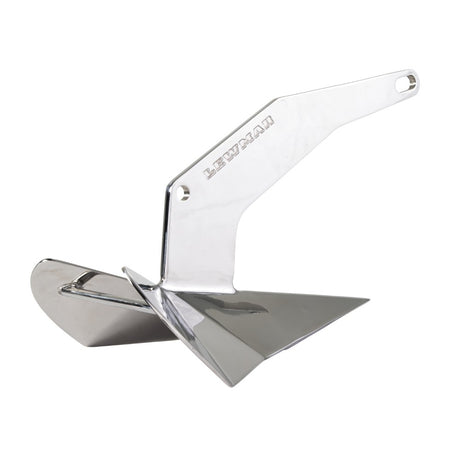
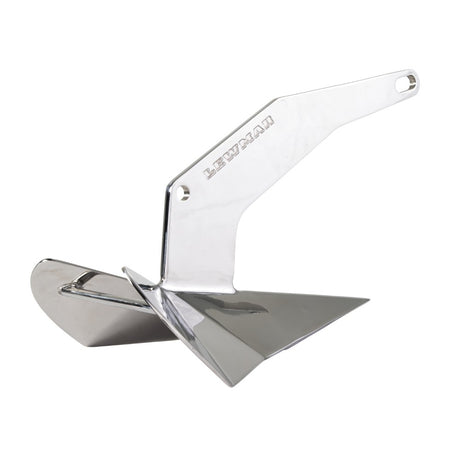
DTX (316 stainless)

| Galvanised part no. | Stainless part no. | Anchor weight | Recommended chain | Galvanised | Stainless |
|---|---|---|---|---|---|
| – | 0057206 | 6 kg / 14 lb | 6–7 mm / 1/4" | – | Stainless → |
| – | 0057210 | 10 kg / 22 lb | 8 mm / 5/16" | – | Stainless → |
| – | 0057216 | 16 kg / 35 lb | 8 mm / 5/16" | – | Stainless → |
| – | 0057220 | 20 kg / 44 lb | 10 mm / 3/8" | – | Stainless → |
| – | 0057225 | 25 kg / 55 lb | 10 mm / 3/8" | – | Stainless → |
| – | 0057232 | 32 kg / 70 lb | 10 mm / 3/8" | – | Stainless → |
| – | 0057240 | 40 kg / 88 lb | 10 mm / 3/8" | – | Stainless → |
| – | 0057250 | 50 kg / 110 lb | 12 mm / 1/2" | – | Stainless → |
| – | 0057263 | 63 kg / 140 lb | 12 mm / 1/2" | – | Stainless → |
Delta®

| Galvanised part no. | Stainless part no. | Anchor weight | Recommended chain | Galvanised | Stainless |
|---|---|---|---|---|---|
| 0057404 | – | 4 kg / 9 lb | 6–7 mm / 1/4" | Galvanised → | – |
| 0057406 | 0057306 | 6 kg / 14 lb | 6–7 mm / 1/4" | Galvanised → | Stainless → |
| 0057410 | 0057310 | 10 kg / 22 lb | 8 mm / 5/16" | Galvanised → | Stainless → |
| 0057416 | 0057316 | 16 kg / 35 lb | 8 mm / 5/16" | Galvanised → | Stainless → |
| 0057420 | 0057320 | 20 kg / 44 lb | 10 mm / 3/8" | Galvanised → | Stainless → |
| 0057425 | 0057325 | 25 kg / 55 lb | 10 mm / 3/8" | Galvanised → | Stainless → |
| 0057432 | 0057332 | 32 kg / 70 lb | 10 mm / 3/8" | Galvanised → | Stainless → |
| 0057440 | 0057340 | 40 kg / 88 lb | 10 mm / 3/8" | Galvanised → | Stainless → |
| 0057450 | 0057350 | 50 kg / 110 lb | 12 mm / 1/2" | Galvanised → | Stainless → |
| 0057463 | 0057363 | 63 kg / 140 lb | 12 mm / 1/2" | Galvanised → | Stainless → |
CQR®

| Galvanised part no. | Stainless part no. | Anchor weight | Recommended chain | Galvanised | Stainless |
|---|---|---|---|---|---|
| 0056503 | – | 7 kg / 15 lb | 6 mm / 1/4" | Ask us to source it → | – |
| 0056504 | – | 9 kg / 20 lb | 8 mm / 5/16" | Ask us to source it → | – |
| 0056505 | – | 11 kg / 25 lb | 8 mm / 5/16" | Ask us to source it → | – |
| 0056506 | – | 16 kg / 35 lb | 8 mm / 5/16" | Ask us to source it → | – |
| 0056507 | – | 20 kg / 44 lb | 10 mm / 3/8" | Ask us to source it → | – |
| 0056508 | 0056205 | 27 kg / 60 lb | 10 mm / 3/8" | Ask us to source it → | Stainless → |
| 0056509 | 0056206 | 34 kg / 75 lb | 11 mm / 7/16" | Ask us to source it → | Stainless → |
| 0056510 | 0056207 | 48 kg / 105 lb | 11 mm / 7/16" | Ask us to source it → | Stainless → |
| 0056511 | 0056208 | 66 kg / 140 lb | 12.5 mm / 1/2" | Ask us to source it → | Stainless → |
| 0056513 | 0056209 | 81 kg / 180 lb | 12.5 mm / 1/2" | Ask us to source it → | Ask us to source it → |
| 0056515 | 0056210 | 108 kg / 240 lb | 14 mm / 9/16" | Ask us to source it → | Ask us to source it → |
| 0056530 | 0056211 | 137 kg / 300 lb | 14 mm / 9/16" | Ask us to source it → | Ask us to source it → |
| 0056540 | – | 182 kg / 400 lb | 16 mm / 5/8" | Ask us to source it → | – |
| 0056550 | – | 227 kg / 500 lb | 17.5 mm / 11/16" | Ask us to source it → | – |
| 0056560 | – | 273 kg / 600 lb | 17.5 mm / 11/16" | Ask us to source it → | – |
Claw

| Galvanised part no. | Stainless part no. | Anchor weight | Recommended chain | Galvanised | Stainless |
|---|---|---|---|---|---|
| 0057901 | 0058901 | 1 kg / 2.2 lb | 5 mm / 3/16" | Galvanised → | Stainless → |
| 0057902 | 0058902 | 2 kg / 4.4 lb | 5 mm / 3/16" | Galvanised → | Stainless → |
| 0057905 | 0058905 | 5 kg / 11 lb | 5 mm / 3/16" | Galvanised → | Stainless → |
| 0057907 | 0058907 | 7.5 kg / 16.5 lb | 6 mm / 1/4" | Galvanised → | Stainless → |
| 0057910 | 0058910 | 10 kg / 22 lb | 8 mm / 5/16" | Galvanised → | Stainless → |
| 0057915 | 0058915 | 15 kg / 33 lb | 8 mm / 5/16" | Galvanised → | Stainless → |
| 0057920 | 0058920 | 20 kg / 44 lb | 10 mm / 3/8" | Galvanised → | Stainless → |
| 0057930 | 0058930 | 30 kg / 66 lb | 10 mm / 3/8" | Galvanised → | Stainless → |
| 0057950 | 0058950 | 50 kg / 110 lb | 12 mm / 1/2" | Galvanised → | Stainless → |
| 0057980 | 0058980 | 80 kg / 176 lb | 12 mm / 1/2" | Galvanised → | Ask us to source it → |
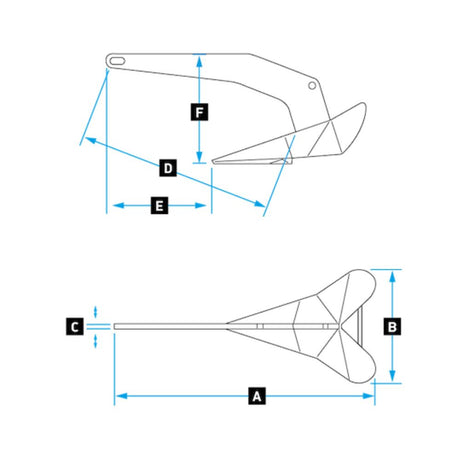
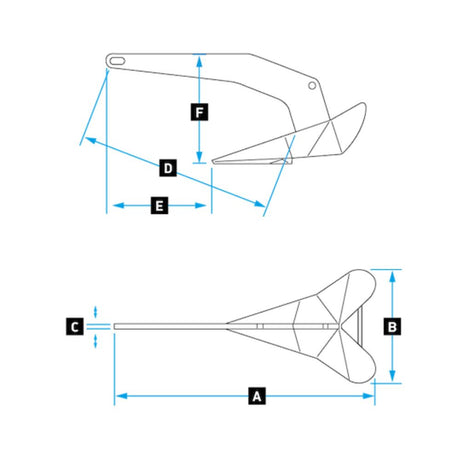
Dimensions in the catalogue are subject to +/- 2% tolerance.
Winch selection guide
Cross-reference your boat length (masthead rigs) or sail area (fractional rigs) with the application to find the winch size. Runner and mainsheet winch selection depends on the purchase system and expected loads; dynamic sail loads can increase loads dramatically. Multihulls have a higher righting moment than monohulls of the same length, so winch size needs to be larger.
Typical sail areas by boat length
| Boat LOA (m) | Boat LOA (ft) | Genoa | Spinnaker | Main |
|---|---|---|---|---|
| 6.1–7.6 | 20–25 | 200 ft² / 19 m² | 300 ft² / 28 m² | 120 ft² / 11 m² |
| 7.6–8.8 | 25–29 | 300 ft² / 28 m² | 400 ft² / 37 m² | 150 ft² / 14 m² |
| 8.8–10.1 | 29–33 | 350 ft² / 33 m² | 600 ft² / 56 m² | 180 ft² / 17 m² |
| 10.1–10.7 | 33–35 | 470 ft² / 44 m² | 800 ft² / 74 m² | 210 ft² / 20 m² |
| 10.7–11.3 | 35–37 | 550 ft² / 51 m² | 1000 ft² / 93 m² | 230 ft² / 21 m² |
| 11.3–11.9 | 37–39 | 600 ft² / 56 m² | 1200 ft² / 111 m² | 260 ft² / 24 m² |
| 11.9–12.5 | 39–41 | 750 ft² / 70 m² | 1400 ft² / 130 m² | 300 ft² / 28 m² |
| 12.8–14.6 | 42–48 | 900 ft² / 84 m² | 1600 ft² / 149 m² | 350 ft² / 33 m² |
| 14.6–16.8 | 48–55 | 1500 ft² / 139 m² | 3000 ft² / 279 m² | 750 ft² / 70 m² |
| 16.8–18.9 | 55–62 | 1900 ft² / 177 m² | 3800 ft² / 353 m² | 875 ft² / 81 m² |
| 18.9–21.6 | 62–71 | 2300 ft² / 214 m² | 4600 ft² / 427 m² | 1000 ft² / 93 m² |
Winch size by application
Genoa sheet, spinnaker sheet, main sheet, genoa, spinnaker and main halyards, and runners, for winch sizes 6 to 70. Lighter shading is the upper limit of the model – if in doubt, move up a model.

Purchase systems and block loads
Purchase required = output force ÷ input from control line or winch (e.g. 200kg ÷ 25kg = 8:1). Winch output = winch model number × 15kg (single-handed) or × 25kg (double-handed). An average person can adjust control lines loaded to 25kg and exert 15kg single-handed or 25kg double-handed on a winch handle.
Typical purchases by boat size
| System | 4 m / 13 ft | 6 m / 20 ft | 8 m / 26 ft | 10 m / 33 ft | 12 m / 39 ft | 14 m / 45 ft | 16 m / 53 ft |
|---|---|---|---|---|---|---|---|
| Mainsheet – hand | 3:1 | 4:1 | 4:1 | 5:1–10:1 | 8:1–24:1 | – | – |
| Mainsheet – winched | – | – | – | 3:1 | 4:1 | 4:1 | 4:1 |
| Vang – cruising | 4:1 | 4:1 | 4:1 | 6:1 | 8:1 | 10:1 | 10:1 |
| Vang – racing | 5:1 | 6:1 | 8:1 | 12:1 | 24:1 | 36:1 | 48:1 |
| Car tow – cruising | – | – | 2:1 | 2:1 | 2:1 | 3:1 | 3:1 |
| Car tow – racing | – | 2:1 | 3:1 | 6:1 | 10:1 | 2:1 (winch) | 2:1 (winch) |
Typical winch output loads
| Winch size | 30 | 40 | 45 | 50 | 55 |
|---|---|---|---|---|---|
| One-handed input, 15 kg on handle → winch output | 450 kg | 600 kg | 660 kg | 720 kg | – |
| Two-handed input, 25 kg on handle → winch output | – | – | 1100 kg | 1200 kg | 1350 kg |
Some typical systems in use
| Boat type | Backstay | Mainsheet traveller | Mainsheet coarse tune | Extra purchase for mainsheet fine tune | Jib traveller | Vang | Cunningham |
|---|---|---|---|---|---|---|---|
| Racing dayboat | 16:1 cascade | 2:1 | 2:1 | 4:1 multi-purchase | Plunger | 8:1 combination | 4:1 cascade |
| Small cruiser | Fixed | 2:1 | 4:1 multi-purchase | – | Plunger | 4:1 multi-purchase | N/A |
| Small racing yacht | 16:1 combination | 8:1 multi-purchase | 6:1 multi-purchase | 4:1 multi-purchase | 8:1 combination | 20:1 combination | 4:1 cascade |
| Medium cruiser | Fixed | 4:1 | 4:1 | N/A | 2:1 with plunger | 5:1 | N/A |
| Medium racing yacht | Hydraulic | 12:1 combination | 2:1 Winched | N/A | 12:1 combination | 36:1 combination | 6:1 combination |
| Large cruiser | Hydraulic | 6:1 | 4:1 Winched | N/A | 2:1 with plungers | 8:1 | 4:1 |
| Large racing yacht | Hydraulic | 2:1 Winched | 2:1 Winched | N/A | 2:1 Winched | Hydraulic | 6:1 combination |
Which bearing?
| Application | Bearing | Recommended Lewmar range |
|---|---|---|
| Frequently adjusted, free, fast-running systems such as sheets or control lines | Ball bearing sheave | Control Block |
| High static loadings, adjusted less frequently and mainly cleated, such as halyards | Free spin bearing | Synchro Block |
| Frequently adjusted, high-loaded systems using modern line with high load on reduced line diameters | Free spin bearing with ball bearing side thrust | HTX Block |
| A combination of the above | Torlon roller bearing | Racing Block |
Block load vs. deflection angle
Match the input from control line or winch to the block's Working Load Limit (WLL), allowing for the deflection angle around the sheave.
| Change of angle | Block load (% of line load) | Change of angle | Block load (% of line load) |
|---|---|---|---|
| 180° | 200% | 90° | 141% |
| 170° | 199% | 80° | 129% |
| 160° | 197% | 70° | 115% |
| 150° | 193% | 60° | 100% |
| 140° | 187% | 50° | 84% |
| 135° | 184% | 45° | 76% |
| 130° | 181% | 40° | 68% |
| 120° | 173% | 30° | 52% |
| 110° | 164% | 20° | 35% |
| 100° | 153% | 10° | 17% |
| 0° | 0% |
| Vertical genoa sheet angle | Car tow load (% of sheet load) |
|---|---|
| 70° | 65% |
| 60° | 50% |
| 50° | 35% |
| 40° | 25% |
| Mainsheet traveller towing load | 25% of mainsheet load |
- Always choose a sheave diameter at least 7x the line diameter.
- Fit blocks so they align with the lines passing through them, particularly multiple blocks and lines that go periodically slack.
- No purchase system is 100% efficient: allow a factor of 1.05 per block, multiplied by the number of 180° turns the rope makes in the system.
Traveller cars and rope clutches
A quick reference for the average modern cruising yacht. Sail area, rig, displacement and multihull or monohull all change the loads: get the loads from the designer and match them to the safe working load of the hardware.
Cars selection guide
| Application / sheeting position | Car size | Towing purchase (maximum available) |
|---|---|---|
| Genoa | 0 | 2:1 |
| End boom mainsheet | 0 | 2:1 |
| Mid boom or multihull | 0 | 2:1 |
| Genoa | 1 | 4:1 or 2:1 to winch |
| End boom mainsheet | 1 | 4:1 |
| Mid boom or multihull | 1 | 4:1 |
| Genoa | 2 | 4:1 or 2:1 to winch |
| End boom mainsheet | 2 | 5:1 |
| Mid boom or multihull | 2 | 5:1 |
| Genoa | 3 | 5:1 or 2:1 to winch |
| End boom mainsheet | 3 | 5:1 or 2:1 to winch |
| Mid boom or multihull | 3 | 5:1 or 2:1 to winch |

Clutch selection guide
DC1 or DC2 rope clutch by application (halyards, gooseneck, pole/boom lift, furling lines, sheets, control lines) and boat length. Lewmar clutches hold lines from 6mm (1/4") to 14mm (9/16").

Need a part that isn't listed? Ask us to source it and quote the part number from the PDF.
Products in this Selection Guide
-


Lewmar Rope Clutch - Single DC2 - Line Size: 1/2 to 9/16 in (12 to 14 mm)
LEW29101414BK
$127.00 USDList Price: $199.95 USDUnit price /Unavailable -

Lewmar Rope Clutch - Single DC1 - Line Size: 3/8 to 1/2 in (10 to 12 mm)
LEW29101112BK
$93.95 USDList Price: $147.95 USDUnit price /Unavailable -
Lewmar Rope Clutch - Single DC1 - Line Size: 5/16 to 3/8 in (8 to 10 mm)
LEW29101110BK
$93.95 USDList Price: $147.95 USDUnit price /Unavailable -
Lewmar Rope Clutch - Double DC1 - Line Size: 5/16 to 3/8 in (8 to 10 mm)
LEW29101210BK
$163.00 USDList Price: $256.95 USDUnit price /Unavailable -
Lewmar Rope Clutch - Double DC1 - Line Size: 3/8 to 1/2 in (10 to 12 mm)
LEW29101212BK
$163.00 USDList Price: $256.95 USDUnit price /Unavailable -
Lewmar Rope Clutch - Single DC2 - Line Size: 3/8 to 1/2 in (10 to 12 mm)
LEW29101412BK
$127.00 USDList Price: $199.95 USDUnit price /Unavailable -
Lewmar Rope Clutch - Single DC1 - Line Size: 1/4 to 5/16 in (6 to 8 mm)
LEW29101108BK
$93.95 USDList Price: $147.95 USDUnit price /Unavailable -
Lewmar Rope Clutch - Triple DC1 - Line Size: 3/8 to 1/2 in (10 to 12 mm)
LEW29101312BK
$233.00 USDList Price: $363.95 USDUnit price /Unavailable -
Lewmar Rope Clutch - Double DC2 - Line Size: 5/16 to 3/8 in (8 to 10 mm)
LEW29102410BK
$226.00 USDList Price: $354.95 USDUnit price /Unavailable -
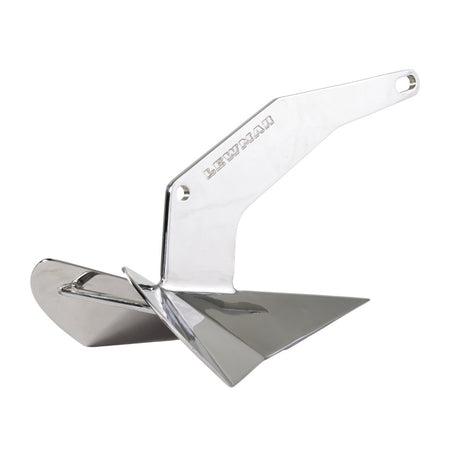
Lewmar Delta Anchor - DTX (Stainless Steel) - 70 lb (31.8 kg)
LEW0057232
$2,330.00 USDList Price: $3,620.95 USDUnit price /Unavailable -
Lewmar Delta Anchor - DTX (Stainless Steel) - 22 lb (10 kg)
LEW0057210
$720.00 USDList Price: $1,124.95 USDUnit price /Unavailable -
Lewmar Rope Clutch - Triple DC2 - Line Size: 1/2 to 9/16 in (12 to 14 mm)
LEW29103414BK
$325.00 USDList Price: $508.95 USDUnit price /Unavailable -
Lewmar Rope Clutch - Triple DC1 - Line Size: 5/16 to 3/8 in (8 to 10 mm)
LEW29101310BK
$233.00 USDList Price: $363.95 USDUnit price /Unavailable -
Lewmar Rope Clutch - Double DC2 - Line Size: 1/2 to 9/16 in (12 to 14 mm)
LEW29102414BK
$226.00 USDList Price: $354.95 USDUnit price /Unavailable -
Lewmar Rope Clutch - DC1 Handle Kit - Black
LEW29100010BK
$31.99 USDList Price: $50.95 USDUnit price /Unavailable -
Lewmar Claw Anchor (Galvanised) - 33 lb (15 kg)
LEW0057915
$152.00 USDList Price: $238.95 USDUnit price /Unavailable -
Lewmar Claw Anchor (Galvanised) - 2.2 lb (1 kg)
LEW0057901
$12.99 USDList Price: $22.95 USDUnit price /Unavailable -
Lewmar Delta Anchor - DTX (Stainless Steel) - 14 lb (6.4 kg)
LEW0057206
$430.00 USDList Price: $672.95 USDUnit price /Unavailable -
Lewmar Windlass - CPX3 1000W Vertical Electric 12V Gypsy Only 10mm - DIN 766
LEW6672211002
$2,030.00 USDList Price: $3,385.95 USDUnit price /Unavailable -
Lewmar Windlass - V4/5 Gypsy Drum Deck Unit (Gypsy Sold Separetely)
LEW66810025
$1,730.00 USDList Price: $2,882.95 USDUnit price /Unavailable -
Lewmar Windlass - Pro-Series 1000 Free Fall 150W Horizontal Electric 12V Gypsy Only 6/7mm - DIN 766
LEW6657011967311
$1,370.00 USDList Price: $2,282.95 USDUnit price /Unavailable -
Lewmar Rope Clutch - Triple DC2 - Line Size: 3/8 to 1/2 in (10 to 12 mm)
LEW29103412BK
$325.00 USDList Price: $508.95 USDUnit price /Unavailable -
Lewmar Rope Clutch - Double DC2 - Line Size: 3/8 to 1/2 in (10 to 12 mm)
LEW29102412BK
$226.00 USDList Price: $354.95 USDUnit price /Unavailable -
Lewmar Rope Clutch - Double DC1 - Line Size: 1/4 to 5/16 in (6 to 8 mm)
LEW29101208BK
$163.00 USDList Price: $256.95 USDUnit price /Unavailable